

ISSB Test Preparation 2026 – Psychological, Intelligence and Interview Complete Guide
My cousin Omar spent seven months preparing for ISSB. He ran every morning, memorized general knowledge facts, practiced intelligence tests, and read every book he could find about military psychology. When the call finally came, he traveled to Kohat with genuine excitement and what he thought was solid preparation.
He came back four days later. Recommended.
The interesting part is not that he passed. The interesting part is what he told me afterward. He said the things he had worried about most the intelligence tests, the physical tasks, the command tasks were not what made the difference. What made the difference was something he almost did not prepare for at all. The way he carried himself. How he talked to other candidates. What happened when things went wrong during a task and nobody was watching him closely.
That conversation changed how I understood ISSB completely. This guide is what I wish someone had given Omar before he went and what I know will genuinely help you prepare for ISSB in 2026.
What ISSB Actually Is and Why Most People Misunderstand It
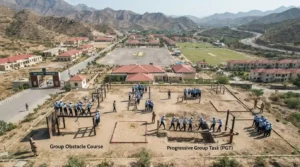
Many candidates think ISSB is just another exam. They study hard, memorize answers, perform well on the tests, and expect to leave with a recommendation.
In reality, ISSB is not an exam. it is an observation.
Throughout the four-day selection process, psychologists, GTO officers, and interview panels carefully observe how you behave in different situations. They are not looking for the smartest candidate. Instead, they want to see whether you can lead under pressure, communicate confidently, stay calm in difficult situations, and work effectively as part of a team.
This is why some candidates who prepare only for the written tests do not succeed, while others with strong leadership qualities, confidence, and good character are recommended even if their intelligence test scores are average.
If you are preparing for ISSB then you are likely also applying through Pakistan Army Jobs 2026 visit our daily updated listings to stay informed about the latest recruitment announcements.
Once you understand this, your entire approach to ISSB preparation changes. It becomes less about memorizing answers and more about developing the qualities that the selection board is actually looking for.
The Four Main Components of ISSB
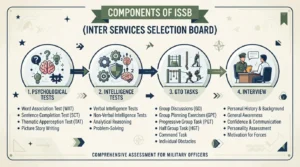
ISSB has four main areas that are evaluated across four days. Knowing what each one measures helps you prepare the right way.
- Psychological Tests These are written tests conducted on Day One. They include the Word Association Test, Sentence Completion Test, Self Description Test, and Thematic Apperception Test. The psychologist uses your responses to understand your personality, emotional stability, stress response, and how you perceive the world around you.
- Intelligence Tests Verbal and non-verbal intelligence assessments covering analogies, series completion, spatial reasoning, and problem-solving. These are timed and cover a broad range of patterns and logical thinking.
- GTO Tasks Group Testing Officer tasks are physical and group-based activities including group discussions, command tasks, group obstacle races, individual obstacles, the snake race, and progressive group tasks. These show how you perform in a team, whether you lead effectively, and how you handle failure and frustration.
- Interview A one-on-one interview with a senior military officer that can last anywhere from fifteen minutes to over an hour. It covers your background, motivations, awareness, and personality in depth.
| ISSB Component | Day | What is Assessed | Preparation Focus |
|---|---|---|---|
| Intelligence Tests | Day 1 | Verbal and non-verbal reasoning, speed, accuracy | Daily past paper practice for 4 to 6 months |
| Psychological Tests | Day 1 | Personality, emotional stability, self-perception | Consistency, positive thinking habits, honest self-reflection |
| GTO Tasks | Day 2 and 3 | Leadership, teamwork, physical confidence, decision-making | Group practice, physical fitness, task simulations |
| Interview | Day 4 | Self-awareness, current affairs, motivation, honesty | Current affairs reading, self-description, recorded practice |
Day by Day – What Actually Happens at ISSB
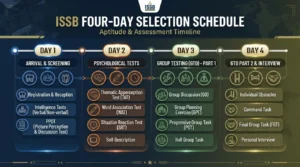
Day One: Psychological Tests and Intelligence Assessment
You arrive, settle in, and the day begins with the intelligence test battery. These are multiple choice and timed, covering verbal reasoning, numerical ability, and spatial intelligence. After lunch comes the psychological tests Word Association, Sentence Completion, Self Description, and TAT.
This day sets a psychological baseline that the assessors refer to throughout the remaining days. Your responses here matter more than most candidates realize.
Day Two and Three: GTO Tasks
These two days are physically and mentally demanding. You will be placed in a group of eight to twelve candidates and put through a series of outdoor and indoor tasks together. The GTO watches everything who leads, who follows, who panics, who helps others, who tries to take over when it is not their turn, and who quietly contributes without seeking attention.
Day Four: Interview and Final Observation
The interview happens on the final day. By this point the psychologist and GTO have already formed opinions. The interview either confirms or adjusts those impressions. After the interview, the final conference of all assessors produces the recommendation or non-recommendation decision.
Psychological Tests How to Actually Prepare

The psychological tests catch most candidates off guard because there are no right or wrong answers in the traditional sense. What the psychologist is looking for is consistency, positivity, emotional maturity, and a clear sense of self.
Word Association Test
You are given sixty words and sixty seconds to write whatever word comes to mind first for each one. The instruction sounds simple but the speed is the point. When you have no time to overthink, your genuine associations emerge.
Prepare by reading broadly, staying positive in your daily thinking, and avoiding negative associations. Before ISSB, spend two weeks consciously noticing when you have negative or anxious thoughts and replacing them with constructive ones. This is not about faking your personality. It is about genuinely building the mental habits that lead to positive associations.
Sentence Completion Test
You are given the beginning of sentences and asked to complete them quickly. Sentences like “When I am under pressure I…” or “My biggest worry is…” reveal your thought patterns about challenges, relationships, authority, and yourself.
Complete these honestly but through the lens of someone who handles difficulties constructively. If pressure genuinely makes you freeze up, work on that in real life before ISSB do not just write what you think they want to hear because trained psychologists can spot inconsistency across multiple tests.
Self Description Test
You write five short paragraphs: what your parents think of you, what your friends think of you, what your teachers think of you, what your supervisors think of you, and what you think of yourself. Keep these consistent with your actual interview answers. Inconsistency across the test and interview raises immediate red flags.
Thematic Apperception Test
You are shown a series of ambiguous pictures and asked to write a short story about each one. The psychologist analyzes your themes, the way your characters handle problems, and whether your stories resolve positively or negatively.
Prepare by reading good fiction, practicing writing short stories with constructive narratives, and making sure your characters generally find solutions rather than giving up.
Intelligence Tests Practical Preparation Strategy
The intelligence tests at ISSB are not designed to catch geniuses. They test whether you can think clearly under time pressure. The good news is that with consistent practice, most people improve significantly.
- Verbal Intelligence covers analogies, word relationships, and comprehension. Practice daily using ISSB past papers, verbal reasoning books, and online practice platforms. The key is speed combined with accuracy . not just getting answers right but getting them right quickly.
- Non.Verbal Intelligence covers pattern recognition, matrix completion, and spatial visualization. These improve fastest with regular daily practice. Thirty minutes every day for eight weeks will produce noticeably better results than cramming for two weeks before the test.
- Mechanical Aptitude appears in some ISSB assessments and tests basic understanding of how things work . gears, pulleys, levers, and simple machines.
GTO Tasks The Part That Trips Everyone Up
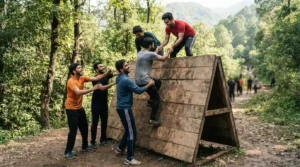
The Group Testing Officer tasks are where most recommendations are earned or lost. Candidates who have been strong on paper sometimes collapse here because they do not understand what is actually being assessed.
Group Discussion
You sit in a circle with your group and discuss a topic. There is no appointed leader. Everyone is equal. The GTO watches who contributes meaningfully, who listens as well as speaks, who bulldozes the conversation, and who says nothing.
The goal is not to talk the most. It is to contribute ideas that genuinely move the discussion forward. Speak clearly, listen actively, build on what others say, and never talk over someone who is mid-sentence.
Command Task
Each candidate takes a turn as the commander and must organize the group to complete a task. You plan, assign roles, and lead.
The biggest mistake candidates make is trying to seem impressive by making the plan too complicated. A simple, clear plan that actually works impresses GTO officers far more than a complicated plan that falls apart.
Individual Obstacles
A physical course with specific obstacles you must complete using available materials. These test physical confidence, creative thinking, and whether you stay composed when the task seems impossible.
Group Obstacle Race
The entire group competes against time to complete an obstacle course together. Leadership emerges naturally here. Who helps teammates? Who pushes ahead and leaves others behind? Who stays calm when the group falls behind schedule?
The Interview What Military Officers Are Actually Looking For
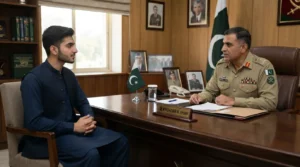
The ISSB interview is conducted by a senior officer who has already reviewed your psychological test results and GTO performance. This is not a surprise attack. It is a conversation designed to confirm or challenge what the assessors already believe about you.
For complete guidance on how ordinary Pakistanis have successfully joined the armed forces, read our detailed guide on how common people join Pakistan Army 2026.
Know your own story
The interviewer will ask about your family background, your education, your failures, your achievements, why you want to join the armed forces, and what you know about Pakistan and current affairs. Know the answers to these questions deeply, not as rehearsed scripts but as genuine reflections on your own life.
Current affairs preparation
Read Dawn newspaper daily for at least three months before ISSB. Know Pakistan’s geographical neighbors, major military operations, current government structure, and at least the basics of international events affecting Pakistan. Interviewers frequently test awareness of current events, and candidates who cannot answer basic questions about their own country make a poor impression.Read Dawn newspaper daily for current affairs preparation it is the single most recommended source for ISSB interview current affairs readiness.
Speak honestly about weaknesses
When asked about your weaknesses . and you will be asked . give a real answer. Interviewers have interviewed thousands of candidates and can immediately identify someone who is giving a rehearsed “my biggest weakness is that I work too hard” type answer. An honest self-aware answer about a real weakness that you are actively working to improve is far more convincing.
Body language matters enormously
Sit upright but not rigid. Make natural eye contact. Do not fold your arms. Speak at a measured pace. Do not interrupt. When you do not know an answer, say so clearly rather than guessing badly. Confidence without arrogance is what the interviewer is evaluating.
Common Mistakes That Cost Candidates Their Recommendation
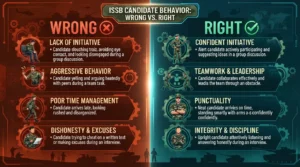
- Trying to dominate every group activity is one of the most common mistakes. Candidates who talk constantly during group discussions, take over command tasks that are not theirs, or push others aside during obstacle races are consistently flagged as poor leadership material. Real leaders create space for others.
- Inconsistency between written tests and interview answers is immediately noticeable to experienced assessors. If your psychological tests suggest anxiety and introversion but your interview presents someone as highly confident and socially dominant, the inconsistency itself becomes the problem.
- Neglecting physical fitness can reduce your chances during GTO tasks. You do not need to be an athlete, but you should have basic fitness the ability to run, climb, and complete physical tasks without becoming exhausted or giving up halfway.
- Focusing only on the formal tests while ignoring your behavior between activities is a significant mistake. What happens during meals, in the dormitory, and in informal moments is also observed. How you treat other candidates, whether you help someone who is struggling, and whether you behave consistently even when you think no one is watching all contribute to the final assessment.
A Realistic Timeline for ISSB Preparation
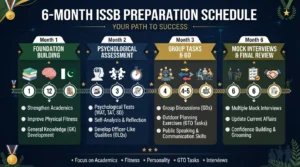
Six months of consistent preparation is ideal. Here is how to structure it:
- Months One and Two focus on intelligence test practice. Thirty minutes daily of verbal and non-verbal reasoning. Build the habit before adding more.
- Months Three and Four add current affairs reading and psychological test practice. Read one newspaper daily. Practice sentence completion and word association exercises. Work on your self-description and make sure it is consistent with how people actually describe you.
- Months Five and Six focus on physical fitness, GTO task practice with friends, and interview preparation. Record yourself answering interview questions and watch the recordings. Practice group discussions with friends or in any group setting. Run, do bodyweight exercises, and build physical confidence.
ISSB Preparation Resources That Actually Work
- The ISSB preparation book by Major Syed Muzammil Shah is one of the most widely used resources in Pakistan and covers psychological tests and intelligence patterns in detail.
- Dawn newspaper and its weekly magazine are among the best resources for current affairs. Reading them regularly for several months helps build the awareness expected during the ISSB interview.
- Practice with past ISSB intelligence test papers available at major bookshops in Rawalpindi, Lahore, and Karachi. These papers follow the actual ISSB pattern and are more useful than general aptitude books.
- YouTube channels dedicated to ISSB preparation can also be helpful, especially for understanding GTO tasks, as they allow candidates to visualize the outdoor activities before appearing at the ISSB.
- Browse our PAF Jobs 2026 and Pakistan Navy Jobs 2026 sections for the latest ISSB-required commission opportunities updated daily.
- For official ISSB information including location, contact details, and reporting instructions visit issb.gov.pk the only official Inter Services Selection Board website.
What Separates Recommended Candidates from Everyone Else
Omar told me something on the night he came back from ISSB that I have thought about many times since. He said the candidates who got recommended were not the ones who performed the best. They were the ones who seemed most genuinely themselves throughout the four days.
That is the real lesson.
ISSB is not looking for a performance. It is looking for a person. Someone who is confident without being arrogant, helpful without being a pushover, honest without being careless, and motivated by something real rather than just wanting a uniform.
If you spend the next six months not just practicing tests and tasks but genuinely working on becoming someone with those qualities, your ISSB result will reflect that.
That is the preparation nobody tells you about. And it is the most important one.
Frequently Asked Questions (FAQs):
How many times can you appear for ISSB in Pakistan?
The number of ISSB attempts allowed depends on the specific commission or entry you are applying for. For PMA Long Course, candidates are generally allowed three attempts before being permanently barred. For other commissions the rules may differ. Your previous ISSB appearance history is on record and the assessors are aware of it. Candidates who appear multiple times are sometimes asked about their previous attempts and what they have done to improve since then. Always check the specific advertisement for the attempt limit applicable to your entry.
What is the most important thing to prepare for ISSB?
Most candidates focus almost entirely on intelligence tests and GTO task techniques. While both matter, the most important thing to prepare is your genuine character and consistency across all four days. ISSB assessors are trained to observe how you behave when you think nobody is watching, how you treat other candidates informally, and whether the person in the psychological test booklet matches the person sitting in the interview chair. Candidates who are genuinely confident, honest, helpful, and self-aware consistently outperform candidates who have memorized techniques but lack real substance.
How should I prepare for the ISSB psychological tests?
Start at least three months before your ISSB date. For Word Association Test practice, write the first word that comes to mind for common words daily until positive associations become natural. For Sentence Completion practice, complete sentences about challenges, relationships, and yourself in a constructive way. For Self Description Test, write honest paragraphs about how different people in your life see you and make sure these match what you would say in your interview. For TAT practice, look at ambiguous images and write short stories where characters face problems and find solutions. The key across all psychological tests is genuine consistency, not rehearsed performance.
What should I read for ISSB interview current affairs preparation?
Read Dawn newspaper every day for at least three months before your ISSB date. Focus on Pakistan's domestic political situation, major ongoing military operations, Pakistan's foreign policy relationships especially with neighboring countries, economic developments, and major international events that affect Pakistan. Know Pakistan's provinces, major cities, rivers, mountain ranges, and neighboring countries thoroughly. Know the basic structure of Pakistan's government and armed forces. Know who currently holds major positions including the Prime Minister, Chief of Army Staff, and relevant cabinet ministers. Interviewers test this knowledge directly and candidates who clearly read current news consistently make a stronger impression than those who have only memorized facts from old books.