

How to Prepare for NTS, PPSC, FPSC Tests 2026 – Complete Strategy
One of my friends named Saad applied for a PPSC position three times. The first time he barely looked at the syllabus and trusted his general knowledge. The second time he bought every preparation book he could find and read them cover to cover without doing a single practice test. The third time he finally passed.
When I asked him what changed the third time, his answer surprised me. He said he stopped preparing more and started preparing smarter. He identified exactly which topics appeared most frequently, focused his energy there, and practiced under timed conditions every single day for eight weeks.
That conversation stuck with me because I had watched so many people around me fail these tests not because they were not intelligent enough but because they were not preparing the right way. The NTS, PPSC, and FPSC tests are very specific in what they ask. Knowing how they work before you start studying changes everything.
If you are preparing for NTS or PPSC tests then you are likely also looking for verified government job opportunities. Browse our Government Jobs Pakistan 2026 section for daily updated listings across all provinces.
This is that guide.
Why So Many Smart People Fail These Tests

The most common reason intelligent candidates fail NTS, PPSC, and FPSC tests has nothing to do with intelligence. It has everything to do with preparation strategy.
Most people study the way they studied in school. They read chapters, highlight important lines, and trust that the information will come back to them when needed. That approach does not work for competitive tests where hundreds or thousands of candidates are all competing for a small number of positions and where the difference between passing and failing can be a single question.
The second common reason is underestimating the breadth of these tests. Candidates who have strong English skills but weak mathematics often lose marks in the quantitative section. Candidates who know General Knowledge but have not looked at the specific syllabus often spend weeks studying topics that barely appear.
The third reason is not practicing under actual test conditions. Reading information is entirely different from recalling it accurately under time pressure when you are nervous and sitting in a real examination hall.
Understanding these three failure points is where smart preparation begins.
Understanding the Difference Between NTS, PPSC, and FPSC
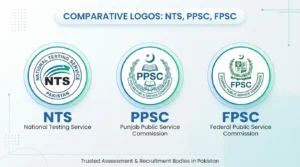
For complete guidance on applying for government jobs in Pakistan read our detailed CV Writing Guide for Pakistan Jobs 2026 to make sure your application is ready when you pass. Before building your preparation strategy you need to understand that these three testing bodies are not interchangeable. They have different formats, different difficulty levels, and different subject weightages.
- NTS (National Testing Service): conducts tests for a wide range of positions across federal government organizations, universities, and some provincial departments. NTS tests are generally structured around four sections: English, General Knowledge, Analytical Reasoning, and a subject-specific section depending on the position. The questions tend to be straightforward and factual rather than deeply analytical.
- PPSC (Punjab Public Service Commission): conducts competitive examinations for Punjab government positions. PPSC papers are considered more rigorous than general NTS tests and place stronger emphasis on Pakistan Studies, Islamic Studies, Everyday Science, and Current Affairs in addition to English and mathematics. PPSC also has a larger proportion of subjective questions for senior positions.
- FPSC (Federal Public Service Commission): conducts the CSS examination and other federal competitive tests. CSS is among the most challenging competitive examinations in Pakistan. FPSC tests for other positions vary in difficulty but generally require strong conceptual understanding rather than just factual recall.
Knowing which body you are preparing for tells you exactly where to direct your energy.
| Feature | NTS | PPSC | FPSC |
|---|---|---|---|
| Difficulty Level | Moderate | Moderate to High | High |
| Question Type | MCQs only | MCQs and subjective | MCQs and essays |
| English Weight | 20 to 25% | 20 to 30% | 30 to 40% |
| Current Affairs | Moderate | High | Very High |
| Preparation Time | 4 to 8 weeks | 8 to 12 weeks | 6 to 12 months |
| Official Website | nts.org.pk | ppsc.gop.pk | fpsc.gov.pk |
Building Your Preparation Plan The Right Way

Most candidates make the mistake of starting to study without a plan. They open a preparation book and start from page one. Six weeks later they are exhausted and have covered more material than they can actually retain.
The better approach starts with the syllabus, not the textbook.
- Step One: Get the official syllabus
Every NTS, PPSC, and FPSC test has an official syllabus or at minimum a past paper pattern. Download this before you buy a single book. The syllabus tells you exactly what topics are tested and in what proportion. This is the most important document in your preparation.
For PPSC, the official website at ppsc.gop.pk publishes past papers and test patterns. For FPSC, fpsc.gov.pk has detailed CSS and departmental test syllabi. For NTS, nts.org.pk lists the format for specific tests.Download your official test syllabus and past papers directly from ppsc.gop.pk, fpsc.gov.pk, and nts.org.pk before buying any preparation book.
- Step Two: Analyze past papers before you start studying
Get the last five to ten years of past papers for your specific test. Before reading a single chapter, go through these papers and mark which topics appear most frequently. You will quickly see patterns. General Knowledge about Pakistan appears constantly. Basic English grammar appears constantly. Mathematics at the Intermediate level appears constantly. Islamic Studies fundamentals appear in almost every government test.
This analysis tells you where to invest your time.
- Step Three: Create a topic priority list
After analyzing past papers, create a priority list with three categories. High priority topics are those that appear in every paper or nearly every paper. Medium priority topics appear occasionally. Low priority topics appear rarely. Spend sixty percent of your study time on high priority topics, thirty percent on medium, and ten on low.
This alone dramatically improves most candidates’ results.
- Step Four: Set a daily practice target
Not a reading target. A practice target. The goal every day is to answer a specific number of practice questions under timed conditions. Start with thirty questions per session and build to a full mock test every weekend.
English Preparation What These Tests Actually Ask

English in NTS, PPSC, and FPSC tests follows consistent patterns that are very learnable with the right focus.
- Vocabulary is tested through synonym and antonym questions, fill in the blank sentences, and reading comprehension. Build vocabulary by learning ten new words daily from a GRE or SAT wordlist. Dawn newspaper is also an excellent daily source of high-level vocabulary used in academic and formal writing contexts.Read Dawn newspaper online for free daily current affairs preparation it is the single most recommended source for competitive test readiness in Pakistan.
- Grammar questions test subject-verb agreement, tense consistency, preposition usage, and sentence structure. The fastest way to improve is to work through grammar exercises specifically designed for competitive exams rather than reading grammar rules in the abstract.
- Reading comprehension passages in PPSC and FPSC tests require you to read a short passage and answer questions about its meaning, tone, and implications. Practice this by reading one Dawn editorial daily and asking yourself what the main argument is, what the author’s tone is, and what conclusions can be drawn.
- Sentence correction is a staple of almost every test. A sentence is given with one or more underlined portions and you identify the error. Common errors tested are subject-verb agreement, pronoun-antecedent agreement, parallel structure, and dangling modifiers.
General Knowledge and Pakistan Studies
This is the section where candidates who read regularly have a natural advantage. But even if you are not a regular reader, you can cover the most frequently tested areas systematically.
- Pakistan geography is tested constantly. Know the provinces, major cities, rivers, mountain ranges, dams, and neighboring countries. Know the length of major rivers, the location of major dams, and the provinces that border other countries.
- Pakistan history from the independence movement through partition, the 1965 and 1971 wars, Bhutto era, Zia era, and subsequent political developments up to 2026 is regularly tested. You do not need encyclopedic depth but you need solid familiarity with key events, dates, and figures.
- Current affairs from the last twelve months are included in almost every test. Read Dawn newspaper daily. Subscribe to their weekly magazine. Keep a running notebook of major events, new appointments, and significant policy changes.
- Islamic Studies basics including the five pillars, important dates in Islamic history, and the names and significance of major Islamic figures appear consistently in government test papers.
Mathematics and Analytical Reasoning

This section causes the most anxiety among candidates who have not studied mathematics since school. The good news is that the mathematics tested in NTS and PPSC is almost entirely at Matriculation and Intermediate level percentages, ratios, basic algebra, simple geometry, and profit and loss problems.
The bad news is that knowing how to solve these problems at school pace is very different from solving them accurately under test conditions in thirty seconds per question.
- Percentages and ratios appear in almost every test. Practice calculating percentages of numbers quickly. Memorize common fraction to percentage conversions.
- Algebra questions involve solving simple equations, finding unknown values, and working with basic formulas. Practice daily with Intermediate level past papers.
- Arithmetic sequences and series appear regularly. Practice identifying patterns and finding missing terms.
- Logical reasoning and analytical questions require identifying patterns, drawing conclusions from given information, and working through syllogisms. Practice these specifically because the skill does not transfer automatically from other types of preparation.
The Books and Resources That Actually Work
Thousands of PPSC and NTS preparation books flood the market but most of them are recycled content from older editions with minimal updates. Here is what actually works.
- Caravan General Knowledge by Imtiaz Shahid remains the most comprehensive single-volume general knowledge resource for Pakistani competitive tests despite being available in various editions for years. Use the most recent edition available.
- Dogar Brothers preparation series for NTS and PPSC covers test-specific content and includes past papers. The quality varies across their publications but their test-specific books are generally useful for pattern familiarization.
- CSS past papers are an excellent resource even if you are not preparing for CSS. They contain high-quality questions on English, Pakistan Studies, and Current Affairs that appear in simplified form in NTS and PPSC tests. Working through CSS past paper questions builds the kind of depth that makes easier tests feel straightforward.
- Dawn newspaper has been mentioned several times already and deserves the repetition. One newspaper read consistently for six months produces current affairs preparation that no book can match.
- Online platforms including Testpoint.pk and similar Pakistani test preparation websites offer subject-wise practice questions and mock tests that mirror actual NTS and PPSC formats.
How to Practice The Method That Actually Builds Your Score
Reading is passive. Answering practice questions under timed conditions is active. Your score improves through active practice, not passive reading.
Here is the daily practice method that works.
Spend the first forty minutes of your study session reading new material in your identified high-priority topics. Then spend the next forty minutes answering practice questions specifically on that topic. Do not check answers while you are practicing. Answer all questions first, then check your answers and review every single question you got wrong.
Understanding why you got a question wrong is more valuable than answering ten more questions correctly. Most candidates skip this step. Do not skip this step.
On weekends, sit a full timed mock test from a past paper without any breaks. Treat it exactly like the actual exam. Sit at a desk, time yourself, and do not use any reference material. After completing it, calculate your score and review every wrong answer in detail.
Track your weekly scores. Improvement should be gradual and consistent. If your scores plateau for two or more weeks, it means you need to change something about your approach usually spending more time on a specific weak area.
Common Mistakes That Keep Candidates Failing
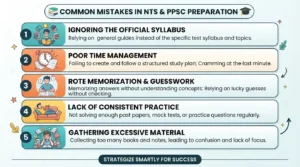
Studying without past papers is the most expensive mistake. Every hour spent studying topics that rarely appear in tests is an hour not spent on topics that appear constantly. Past papers are the map. Do not start the journey without the map.
- Memorizing without understanding causes collapse under pressure. When you memorize a fact without understanding it, the slightest variation in how a question is worded can make a memorized answer feel completely unfamiliar. Build understanding alongside memorization.
- Ignoring weak sections rather than addressing them is a trap. It feels better to practice things you are already good at. But your score is pulled down by your weakest sections more than it is pulled up by your strongest ones. Give extra time to the sections that currently give you the most trouble.
- Not managing time during practice tests means you have not actually prepared for the real test. If you regularly run out of time on practice tests, time management is a preparation issue you must address explicitly. Practice deliberately finishing within the time limit even if it means leaving some questions unanswered initially.
- Starting too late is still the most common mistake. Eight to twelve weeks of consistent daily preparation produces dramatically better results than two or three weeks of intense cramming. Start earlier than you think you need to.
A Realistic Eight Week Schedule
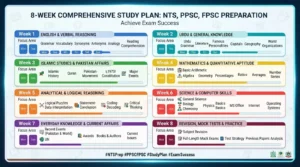
Weeks One and Two: Focus on diagnosing your current level. Take one full past paper on day one before studying anything. Your score tells you exactly where you stand. Spend these two weeks covering the highest priority topics identified from your past paper analysis.
Weeks Three and Four: Cover medium priority topics while continuing to practice high priority areas daily. Start doing timed section practice rather than open-book review.
Weeks Five and Six: Take a full mock test every Saturday under exam conditions. Review all wrong answers in detail. Focus remaining study time on whichever sections are still showing the most errors.
Weeks Seven and Eight: Shift to almost pure practice mode. New reading should be minimal and focused only on filling specific gaps identified from mock tests. Practice a full past paper every two to three days. Focus on speed and accuracy simultaneously.
Once you clear your test, preparing for the interview is the next step. Our Top 10 Interview Tips for Pakistani Job Seekers 2026 covers exactly what to expect.
What to Do in the Final Week Before the Test
The week before the test is not the time to learn new information. Your brain needs consolidation time, not more input.
Spend the final week reviewing your personal notes on high-frequency topics, doing one short practice session daily rather than marathon study sessions, and making sure you know the exact test location, timing, and document requirements well in advance.
Sleep properly every night that week. Performance on standardized tests drops measurably with poor sleep and the effect accumulates across days. A candidate who is well-rested and has covered seventy percent of the syllabus deeply will consistently outperform a candidate who has covered everything shallowly on poor sleep.
On the morning of the test, eat a proper breakfast, arrive early, carry all required documents including CNIC and roll number slip, and go in knowing that you have prepared systematically and given yourself the best possible chance.
Saad passed on his third attempt not because he suddenly became smarter. He passed because he finally prepared in a way that matched how these tests actually work. That is what this guide is trying to help you do from your very first attempt.
Frequently Asked Questions (FAQs):
What books are best for NTS and PPSC preparation in 2026?
Caravan General Knowledge by Imtiaz Shahid remains the most comprehensive single-volume resource for Pakistani competitive tests. For PPSC specifically, Dogar Brothers test-specific books provide useful format familiarization and include past papers. For English preparation, any grammar book designed for competitive exams rather than school curriculum works well. However, the most important resource is not any book but actual past papers from official websites. Analyzing five to ten years of past papers before starting your reading tells you exactly which topics deserve your attention and which can be covered lightly.
How important are current affairs for NTS and PPSC tests?
Current affairs carry significant weight in both PPSC and FPSC tests and moderate weight in most NTS tests. The most effective preparation is reading Dawn newspaper every single day for at least three months before your test date. Keep a personal notebook of major events, new appointments, policy changes, and international developments affecting Pakistan. Books claiming to cover current affairs are outdated by the time they are printed. Only daily newspaper reading provides genuinely current information. For tests happening in 2026, events from the previous twelve months are most likely to appear so consistent daily reading is the only reliable approach.
Should I take a preparation academy or can I self-study for PPSC and FPSC?
Self-study is entirely sufficient for NTS and most PPSC tests provided you have the discipline to study consistently and access to the right resources. Many successful candidates have cleared these tests without any academy. Academies provide structure and peer pressure to study, which genuinely helps some people but is not a substitute for personal consistency and the right strategy. For FPSC CSS, the breadth of the syllabus means that optional subject academies or study groups can be genuinely helpful. For NTS and standard PPSC tests, past papers, a good general knowledge book, and daily current affairs reading combined with consistent timed practice is a complete preparation package.
What is the best way to improve mathematics score for NTS and PPSC tests?
The mathematics tested in NTS and PPSC is almost entirely at Matriculation and Intermediate level covering percentages, ratios, basic algebra, simple equations, profit and loss, and basic geometry. If these concepts feel rusty, spend two weeks reviewing the relevant Intermediate mathematics chapters before moving to practice questions. After reviewing concepts, switch entirely to practice mode. Solve timed mathematics questions every day. The goal is to be able to solve standard question types quickly and accurately, not to understand advanced mathematics. Track how many questions you answer correctly per session and set a weekly improvement target. Most candidates improve their mathematics score by thirty to forty percent within six weeks of consistent daily practice.